
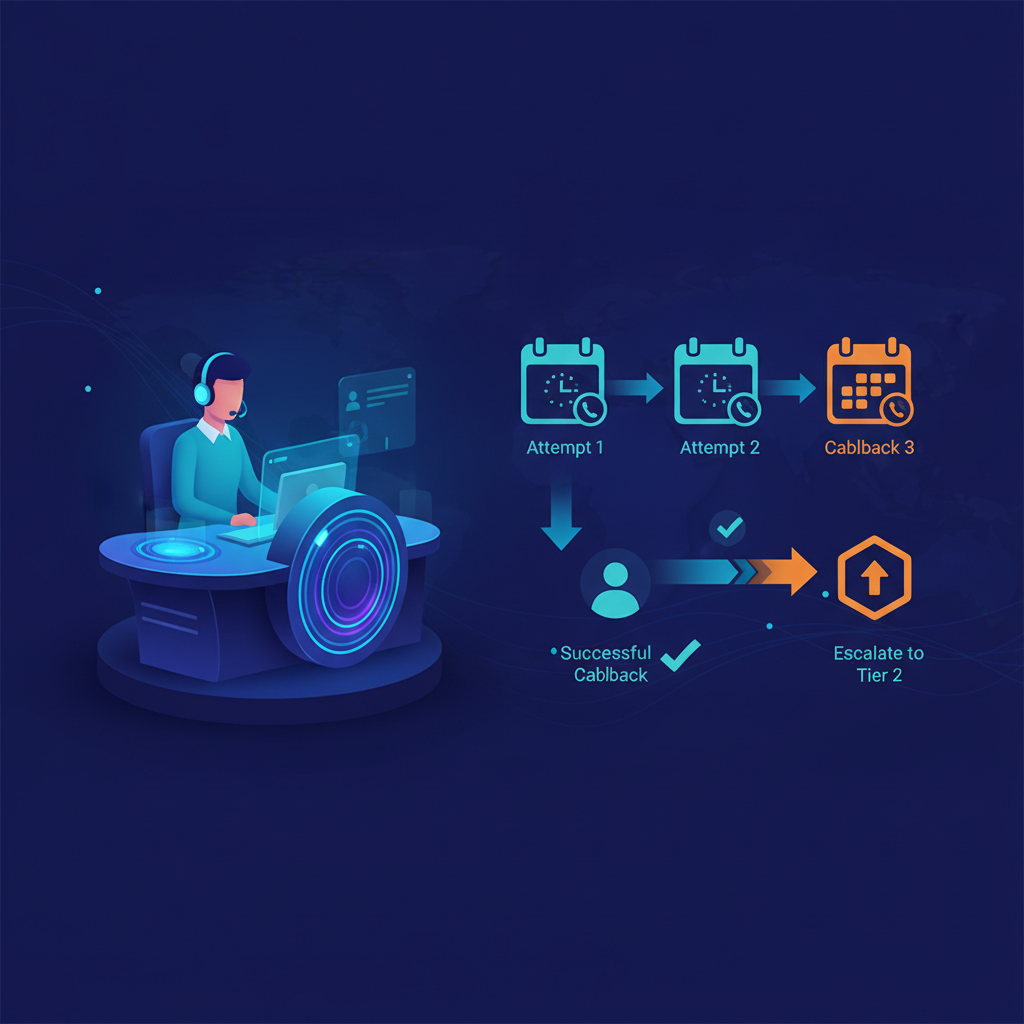
A callback promise creates a small service operation of its own. Someone must know why the call is needed, when the customer is willing to receive it, what has already been attempted, and what happens when contact does not occur. An offshore call center callback ownership window gives that work a visible boundary. It prevents repeated attempts from becoming invisible activity and prevents a missed callback from being treated as a new request with no history.
Define the promise before the attempt
Start with the customer-facing reason for the callback. It may be a response that needs research, a specialist conversation, a requested update, or a recovery after a disconnected call. The record should distinguish a promised callback from a general outbound task. Include the facts already confirmed, the question still open, the permitted contact route, the customer’s stated time preference, and the owner responsible for the next decision.
Do not record a vague window such as “later.” Use a clear time period that the queue can actually manage, plus the relevant time zone or local convention when needed. If the customer has not given a usable window, the agent should follow the approved clarification path rather than inventing one. The purpose is not to create a rigid promise that operations cannot keep. It is to make the promise testable and honest.
Separate ownership from availability. A queue can hold work while one person owns the decision. If an agent is unavailable, the supervisor should know whether another authorized representative may make the callback, whether the customer needs an update first, or whether the item must wait for a specialist. A generic queue assignment is not a substitute for an accountable owner.
Use attempt reasons and stop rules
Every attempt should say what happened: customer reached, no answer, requested time unavailable, wrong route, disconnected call, or another approved outcome. The reason should not expose more customer detail than the workflow needs, but it should be specific enough for the next person to choose a different action. “Tried again” is not a useful operating record.
Set a retry rule before the first attempt. The rule can specify how many attempts are normally permitted, how far apart they should be, and when a different channel requires permission. It should also name exceptions. A customer who asks not to be called at a particular time is not the same as a customer who cannot be reached. A failed route may require correction, while a repeated no-answer event may require a final update or closure.
Stop rules protect both the customer and the queue. Stop when the customer asks for no further calls, when the permitted window expires without an approved extension, when the request is complete, or when the owner lacks authority to continue. Stopping does not mean erasing the history. Preserve the reason, the last customer-facing action, and the next approved path if one exists.
Design the handoff across shifts
An offshore call center often moves work across people and time windows. The handoff should carry the callback purpose, the last confirmed facts, the open question, attempts already made, the next eligible window, and the accountable owner. It should also identify what the receiving representative must not promise. That boundary prevents a well-intentioned agent from offering a result that requires specialist or manager approval.
Make acceptance visible. A transfer is not complete merely because the record entered another queue. The receiving owner should acknowledge the work or return it with a reason. If the callback is approaching its due point without acceptance, the escalation path should be automatic within the operating process: supervisor review, reassignment, or a customer update. The customer should not discover the ownership gap by making another call.
Keep a timeline rather than overwriting the prior attempt. A concise sequence shows when the promise was made, what the customer requested, which attempts occurred, who accepted the work, and why the next action changed. That timeline helps a reviewer distinguish a reasonable retry from a failure to transfer context. It also supports fair coaching because the record reveals whether the obstacle was availability, authority, routing, or execution.
Measure reliability without chasing activity
Count outcomes that matter to the promise. Useful measures may include callbacks completed within the agreed window, returned or unaccepted handoffs, repeat contacts before completion, customer-requested stop events, and records missing a next action. The purpose is not to reward more dialing. A high attempt count can coexist with poor service if the team ignores the customer’s time preference or repeats an unsuitable route.
Review exceptions separately. A callback that requires unusual research should not be compared without context to a simple update. A recurring exception may indicate that the queue’s authority boundary is too narrow, the knowledge path is unclear, or the original intake is missing a required field. Use the pattern to improve the process, not to pressure representatives into making unsupported promises.
Sample the record against the conversation. Confirm that the customer’s request was represented accurately, that contact permission and preferences were respected, and that the final disposition matches what happened. Keep evidence access limited to the approved reviewers. A callback-control process should preserve continuity without turning routine follow-up into unnecessary data collection.
Escalate the right problem
Escalation should answer a decision question. “Please review” is weak. Ask whether the owner can extend the window, whether another authorized route is available, whether the customer needs an update, or whether the request is outside the queue’s role. State the evidence already gathered so the manager can decide without forcing the customer to repeat the story.
If a callback fails because of a system or routing condition, link the customer-facing consequence to the technical owner while keeping the queue responsible for communication. The agent should not diagnose infrastructure during the call. The agent should know how to report the issue, what interim message is approved, and when to return for a status update. This keeps technical and customer responsibilities separate.
An offshore call center callback ownership window works when the promise has a reason, the customer’s timing is respected, each attempt teaches the next action, and a named owner can explain the outcome. The result is not a perfect contact rate. It is a reliable path from request to decision, with clear stops when continued attempts would be unhelpful.
Before expanding the rule across queues, test it on a limited set of callback reasons. Ask representatives where the fields are ambiguous, ask supervisors which exceptions require authority, and inspect whether a receiving owner can understand the timeline. Adjust the rule where evidence shows friction. Then publish the final boundary in the queue’s working guidance so a callback remains accountable even when the day, shift, or representative changes.