
# Offshore Call Center Backlog Aging: Deciding What Needs Attention First
August 21, 2026
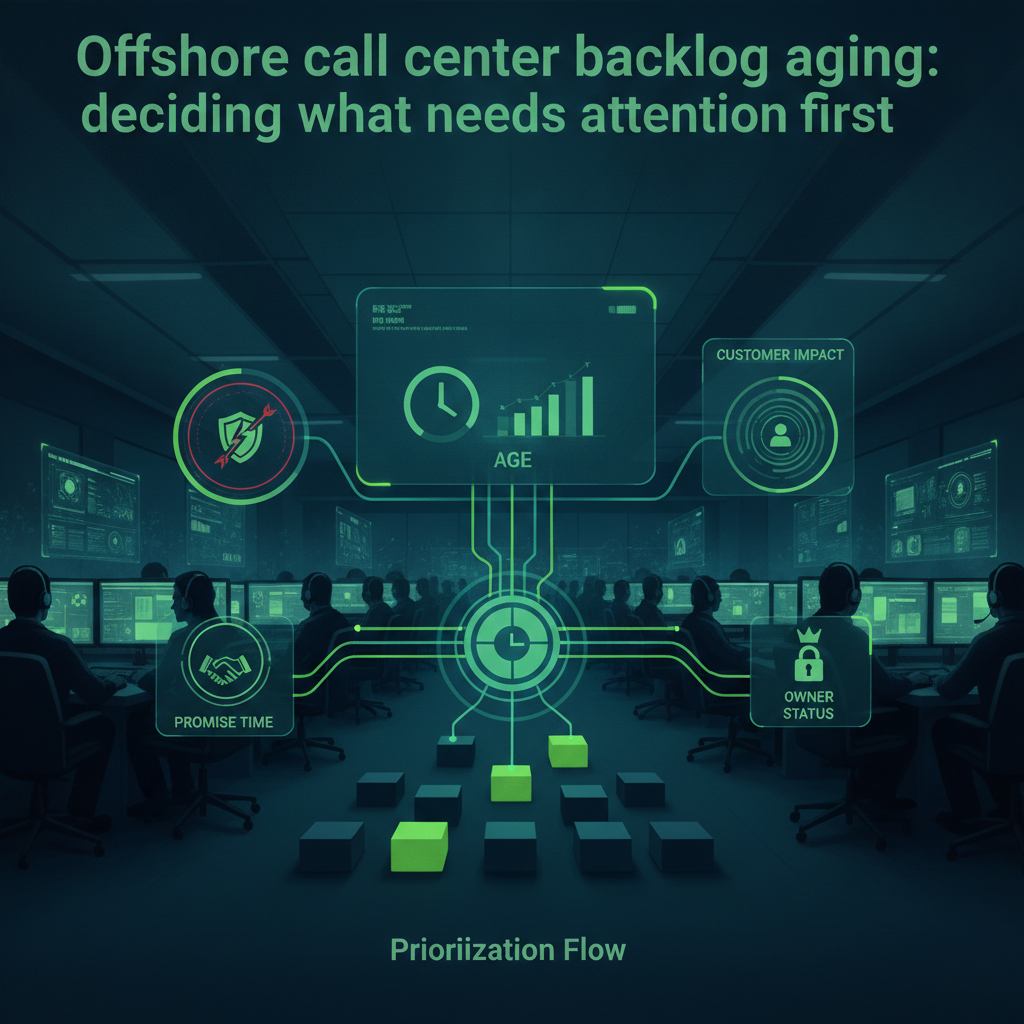
In the high-volume environment of an offshore call center, a backlog isn't merely a sign of inefficiency; it's an inevitable reality. Whether managing customer support queues, meticulously scheduling appointments, or resolving complex technical issues, items will accumulate. The challenge isn't preventing a backlog entirely, but rather strategically managing its aging. A common pitfall is to treat every old item identically, adhering strictly to a "first-in, first-out" (FIFO) principle. This approach can be detrimental, often leading to critical issues languishing while less impactful, albeit older, requests are processed. This guide outlines a structured methodology to prioritize backlog items, leveraging multiple dimensions beyond simple age: risk, promise time, customer impact, and owner status, ensuring that crucial tasks receive the attention they demand.
Beyond Simple Age: Deconstructing Priority
The number of days an item has been open provides some context, but it rarely tells the full story. Consider two items: a customer's request for a password reset that is three days old, and a booking error for a critical medical appointment made just one day ago. A strict FIFO policy would suggest addressing the password reset first. However, the medical appointment error carries significantly higher risk and customer impact, demanding immediate attention.
Effective backlog management requires deconstructing the "age" factor and integrating it with other critical attributes. This multi-faceted approach transforms the backlog from a static list into a dynamic, prioritized workflow, allowing offshore teams to allocate resources where they are most needed. It empowers supervisors and team leads to make informed decisions that align with service level agreements (SLAs), customer satisfaction goals, and operational integrity, rather than simply moving items in chronological order.
The Gravity of Risk and Customer Impact
The inherent risk and potential customer impact associated with an unaddressed backlog item are paramount in determining its urgency. Risk, in an offshore call center context, can encompass financial penalties, reputational damage, regulatory non-compliance, or even data security breaches. Customer impact, on the other hand, considers operational disruption, lost business opportunities, emotional distress, or potential safety concerns for the end-user.
To effectively categorize:
* **Tier 1 (Critical):** Items posing immediate severe risk or impact. Examples include a failed emergency service dispatch, evidence of an unauthorized account access attempt, or a system-wide outage affecting multiple users' ability to access critical services. These often require immediate escalation and intervention, potentially bypassing standard queue processing. * **Tier 2 (High):** Issues with substantial, but not immediate, severe consequences. This might include a missed high-value appointment, a prolonged service outage affecting a single key customer, or a data correction required for regulatory reporting deadlines. * **Tier 3 (Medium):** Standard operational issues with moderate impact. A complex billing discrepancy requiring manual investigation, a non-urgent technical issue that degrades but does not halt service, or a complaint requiring detailed review. * **Tier 4 (Low):** General inquiries, information updates, or minor technical glitches that do not severely impair service. A simple address change request or a query about product features.
**Practical Decisions:** Supervisors, often guided by internal quality assurance (QA) specialists during their review processes, are primarily responsible for the initial triage and classification of incoming items. The criteria for each tier must be clearly defined and universally understood across the offshore operation. **Role Boundaries:** Front-line support agents should be trained to identify potential Tier 1 or 2 issues for immediate supervisor review, but the final classification and priority assignment should reside with team leads or dedicated QA personnel. **Evidence to Retain:** Documenting the risk assessment criteria and the rationale behind specific item classifications is crucial for internal audits, compliance checks, and demonstrating due diligence.
The Weight of Promise Time and Ownership Dynamics
Beyond risk and impact, two other factors significantly influence an item's true urgency: the explicit promise made to the customer and the history of its ownership.
**Promise Time:** This refers to the specific commitment made to a customer regarding resolution or a callback. This might be a service level agreement (SLA) stipulating a 24-hour turnaround for a specific issue type, or an explicit promise made by an agent during a previous interaction. Ignoring these promise times until they are breached is a critical failure mode, transforming proactive service into reactive damage control. For example, a 20-hour-old shipping issue with a 24-hour resolution promise should take precedence over a 48-hour-old general billing inquiry that has no specific resolution deadline. The closer an item gets to its promise time, the higher its effective priority should become, irrespective of its age or even initial risk tier. This prompts proactive engagement, often involving a specialized escalation team to prevent a breach.
**Owner Status (Handoffs and Escalations):** Items that have been handed off between multiple teams or individual agents, or those that have undergone several levels of escalation, often carry hidden complexities and accumulated customer frustration. Each handoff can introduce delays, require re-explanation, or result in lost context. These items are prime candidates for accelerated resolution. **Role Boundaries:** While the initial support agent logs the ticket, subsequent ownership shifts typically occur with a handoff to Tier 2 technical support, an appointment setting specialist, or a dedicated escalation manager. Clear protocols for documenting ownership changes are vital. **Practical Decisions:** Prioritize items where the ownership trail is long or ambiguous. A high number of internal transfers, coupled with an impending promise time, can signify an item requiring immediate leadership attention. This ensures that complex issues don't fall through the cracks of inter-departmental transfers, preventing them from becoming "hot potatoes."
Operationalizing Prioritization: A Measured Implementation Path
Implementing a multi-factor prioritization system requires structure and a phased approach. A practical way to operationalize this is through a weighted scoring mechanism integrated into your existing customer relationship management (CRM) or ticketing system.
1. **Define and Calibrate Categories:** Establish clear, objective definitions for each factor (Risk Tier 1-4, Impact High-Low, Promise Time Remaining bands, Number of Handoffs). Consistency in categorization is key, especially within an offshore setup with multiple teams. 2. **Assign Weights/Scores:** * **Risk:** Assign the highest weight (e.g., Tier 1 = 10 points, Tier 4 = 1 point). * **Customer Impact:** Similar high weighting. * **Promise Time Remaining:** A dynamic score. As the promise time approaches, the score increases (e.g., <2 hours remaining = 8 points, 2-12 hours = 5 points). * **Handoff Count/Escalation Level:** Moderate weight (e.g., 3+ handoffs = 4 points, 1 handoff = 1 point). * **Age:** A lower baseline weight (e.g., 5-7 days old = 2 points, 1-2 days old = 0.5 points), preventing simple age from dominating. 3. **Tooling Integration:** Leverage custom fields, tags, or workflow automation within your CRM to calculate a "Priority Score" dynamically. This score dictates the order of items in agent queues, ensuring they see the most critical items first. 4. **Training and Adoption:** Thorough training for offshore supervisors, QA specialists, and support teams is critical. They must understand the rationale behind the scoring, how to correctly categorize items, and the implications of misclassification. 5. **Measured Implementation:** Begin with a pilot program in a specific queue or with a single team. Gather feedback, refine the weighting and definitions, and then gradually roll out the system across the entire offshore operation. This iterative process allows for adjustments based on real-world performance without disrupting the entire workflow. **Evidence to Retain:** Training modules, scoring rubrics, and pilot program performance reports are essential for demonstrating the system's effectiveness and for future refinements.
Navigating Failure Modes and Ensuring Control
Even the most well-designed prioritization system can falter without robust controls and a keen awareness of potential failure modes.
* **"Everything is Critical" Syndrome:** Without strict definitions and oversight, agents or supervisors might be tempted to mark all items as high priority to expedite them. This dilutes the entire system, making it ineffective. **Access Controls:** Only authorized personnel (supervisors, QA leads, escalation managers) should have the ability to modify high-priority flags or risk classifications. All such changes should be auditable. * **Gaming the System:** Teams might manipulate data to improve their metrics. For instance, artificially closing and reopening tickets to reset age. Robust system design and regular audit checks can mitigate this. * **Lack of Accountability:** A high-priority item doesn't get resolved just because it's tagged as such. Clear ownership, handoff protocols, and accountability for critical backlog items are paramount. **Role Boundaries:** Supervisors must conduct daily backlog reviews, focusing specifically on high-priority items and ensuring they are assigned and progressing. Escalation teams must own critical items from identification to resolution. * **Insufficient Training:** Inconsistent application of prioritization rules across different shifts or teams leads to system breakdown. Continuous training refreshers are necessary. * **System Over-Complexity:** An overly intricate scoring system can be difficult to manage and understand, leading to errors and resistance. Keep it as simple as possible while achieving the desired level of differentiation. **Evidence to Retain:** Audit logs of priority changes, regular reports on backlog age distribution by priority tier, and incident reports on mishandled critical items.
Continuous Improvement and the Evolving Queue
Backlog management is not a static process; it's a dynamic and continuous improvement cycle. The factors influencing priority—service offerings, customer demographics, regulatory changes, or seasonal demand shifts—are constantly evolving. Therefore, the prioritization criteria must also adapt.
Regular review meetings (e.g., weekly or bi-weekly) involving supervisors, team leads, and QA are essential to:
* **Review Criteria Effectiveness:** Analyze if the current weighting system is accurately identifying and prioritizing the most critical items. * **Address Bottlenecks:** Identify specific queues or item types that consistently accumulate, suggesting underlying process issues. * **Incorporate Feedback:** Gather insights from front-line agents and escalation teams regarding the practical application of the system. * **Adapt to Changes:** If a new product is launched, or a regulatory deadline approaches, the risk and impact scores for related issues might need temporary adjustments. For example, a bug in a new feature might initially be a Tier 3 issue, but if it gains widespread adoption and leads to critical data loss, its priority must immediately be elevated.
This proactive approach ensures that the offshore call center remains agile and responsive, not just to current demands, but also to anticipated future challenges.
Effective backlog management transcends simple chronological processing. By strategically prioritizing items based on age, risk, promise time, customer impact, and ownership status, offshore call centers can optimize resource allocation, enhance customer satisfaction, and protect their operational integrity. This structured methodology transforms the daunting task of backlog reduction into a strategic lever for improving overall service delivery and fostering a more mature, customer-centric operation.