
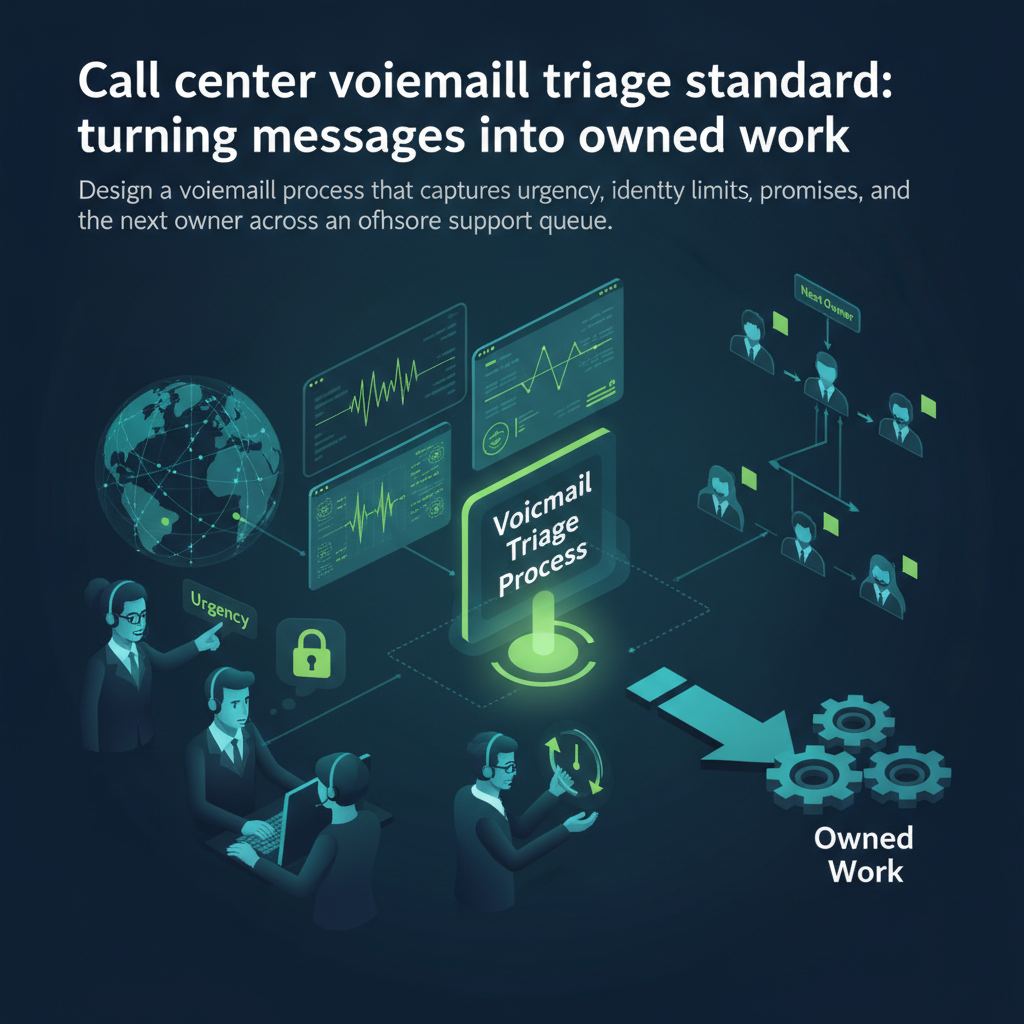
# Call center voicemail triage standard: turning messages into owned work
August 21, 2026
In the intricate ecosystem of offshore call center operations, voicemail can often be perceived as an anachronism – a vestige of older communication methods in an age of instant chat and digital ticketing. Yet, voicemails persist, particularly for customers who prefer direct verbal communication or who call outside of immediate operating hours. Without a structured approach, these messages can quickly become black holes of unowned work, creating service gaps, escalating customer frustration, and undermining the very efficiency an offshore model is designed to provide.
The strategic imperative, therefore, is to transform voicemail from a passive repository into an active, accountable workflow. This requires a robust voicemail triage standard that precisely captures urgency, accurately identifies caller intent within security limits, clarifies callback commitments, and assigns clear ownership across the distributed offshore support queue. This article outlines such a process, turning every recorded message into an actionable item with a designated owner.
Deconstructing the Voicemail: Essential Data Points for Triage
The initial step in turning a voicemail into owned work is a systematic extraction of critical information. The offshore triage team, often operating in a distinct time zone from the customer, plays a pivotal role here. Their process must be meticulous, ensuring no vital detail is overlooked.
1. **Urgency Classification:** Every voicemail must be immediately categorized by its time sensitivity. This isn't a subjective call but an adherence to predefined Service Level Agreement (SLA) tiers. * **Tier 1 (Critical):** Requires immediate action, typically within the next business hour. Examples include service outages, payment failures impacting critical operations, or security alerts. These often trigger an immediate escalation to a dedicated priority queue. * **Tier 2 (High Priority):** Requires a callback or action within 4-8 business hours. This could involve complex technical support issues, high-value account inquiries, or critical appointment changes. * **Tier 3 (Standard):** Requires action within 24 business hours. Most general inquiries, routine requests, or information queries fall into this category. * **Tier 4 (Information Only):** Messages that require no direct action but provide context for future interactions, such as a customer stating they have resolved an issue independently.
2. **Identity and Context Limits:** Capturing caller identity is crucial, but it must be done within the inherent limitations and security protocols of voicemail. * **Caller ID/Stated Name:** Record the inbound number and any name explicitly stated by the caller. Cross-reference this with existing customer records if possible, but acknowledge that a voicemail alone cannot fully authenticate an identity. * **Account/Reference Numbers:** Many callers leave an account number, case ID, or product serial number. This is invaluable for quickly locating their profile within the CRM system. * **Nature of Inquiry:** Briefly summarize the core request or issue. "Customer experiencing login failure on product X," "Requesting to reschedule appliance delivery," or "Billing dispute regarding invoice YYY." This summary is critical for initial routing.
3. **Callback Promises and Availability:** The caller's explicit instructions for follow-up are paramount. * **Preferred Contact Number:** Often different from the inbound number. * **Availability Window:** "Call me after 3 PM EDT" or "I'm available tomorrow morning." * **Any Specific Instructions:** "Please have a Tier 2 technician call me," or "Only speak to Jane Doe at extension 123."
The offshore triage agent's role is not to resolve the issue but to accurately distill these data points. Failure to capture these details accurately results in wasted follow-up attempts, delayed resolutions, and a poor customer experience, especially when dealing with time zone differences that can already complicate callbacks.
Assigning Ownership: Bridging the Offshore-Onshore Divide
Once the voicemail is deconstructed, the next critical step is assigning unambiguous ownership. This process must transcend geographical and team boundaries, ensuring that accountability is clear from the moment the message is processed by the offshore team.
1. **Initial Triage and Documentation (Offshore):** The offshore team responsible for listening to voicemails creates a new case or ticket in the CRM system. All extracted data points – urgency, caller details, summary, callback instructions – are meticulously logged. This initial documentation acts as the foundational record for the entire lifecycle of the voicemail. The offshore agent responsible for this initial triage is the first owner of the *data entry* aspect.
2. **Queue Routing and Hand-off:** Based on the 'Nature of Inquiry' and 'Urgency,' the triaged voicemail case is routed to the appropriate specialized queue. This could be: * **Tier 1 Technical Support (Offshore/Onshore):** For common technical issues. * **Billing/Accounts (Onshore):** Often requires access to specific financial systems or local compliance knowledge. * **Sales/Upgrade Inquiries (Offshore/Onshore):** New leads or product interest. * **Appointment Setting/Logistics (Offshore/Onshore):** Scheduling, rescheduling, or delivery coordination. * **Escalation Queue (Onshore):** For critical issues, VIP customers, or sensitive complaints identified during triage.
The hand-off protocol is paramount: the triaging agent explicitly assigns the case to the target queue. This move instantly transfers the *ownership of resolution* to the next team or individual. Clear, concise hand-off notes detailing the extracted voicemail information are non-negotiable.
3. **Owner Assignment and Acceptance:** Within the receiving queue, the case should be picked up by an available agent or assigned by a team lead. The act of "picking up" or "accepting" the case in the CRM signifies ownership. This creates an audit trail and prevents voicemails from languishing in a general pool. For offshore teams handling the actual resolution, clear dashboards showing unassigned voicemail-initiated cases are essential.
4. **Escalation Pathways:** Certain voicemails, especially those classified as Tier 1, require immediate senior attention or specific onshore expertise. The triage process must include defined triggers for this. For instance, a caller threatening to cancel a high-value contract due to a critical service disruption automatically triggers an escalation to a designated onshore retention specialist, bypassing standard queues. The offshore triaging agent's role here is to recognize the trigger and initiate the correct escalation path, ensuring that the critical message does not get lost in standard routing.
Failure to clearly define these boundaries and hand-off points leads to "hot potato" scenarios where no one truly owns the problem, or worse, cases are simply forgotten.
Tools for Transparency: Documenting and Tracking the Voicemail Journey
Effective voicemail triage is impossible without robust tools that provide transparency, auditability, and a single source of truth. These tools ensure that every message leaves a digital footprint, turning transient audio into permanent, actionable data.
1. **Integrated CRM System:** At the core is a CRM that allows for the creation of new cases or tickets directly from voicemail input. Each case must have fields for urgency, caller details, summary, and callback instructions. This system becomes the central repository for all information related to the voicemail, ensuring all offshore and onshore teams are working from the same data set.
2. **Voicemail Transcription and Audio Attachment:** Modern systems often offer AI-assisted transcription, which is invaluable. * **Transcription:** Provides a text-based, searchable record of the voicemail, accelerating the triage process and improving accuracy by allowing agents to scan for keywords. It also aids in overcoming potential language barrier nuances when an offshore agent needs to quickly grasp the essence of a diverse range of accents. * **Original Audio File:** The actual audio recording must be attached to the CRM case. This serves as critical evidence. It allows for verification of transcribed information, provides context that text alone might miss (e.g., caller's tone indicating frustration), and is essential for quality assurance or dispute resolution. It's the immutable record of the customer's original message.
3. **Metadata Capture:** Beyond the content, capturing metadata is crucial for analytics and accountability: * **Timestamp:** Exact time the voicemail was received and when it was triaged. * **Duration:** Length of the message. * **Caller ID:** Programmatic capture of the inbound number. * **Triage Agent ID:** Identifies the offshore agent who processed the voicemail.
4. **Access Controls and Audit Trails:** Given the distributed nature of offshore operations and the sensitivity of customer information, stringent access controls are necessary. Only authorized personnel should be able to view, edit, or listen to voicemail-related cases. A comprehensive audit trail, logging every action (e.g., case creation, assignment, updates, listen events), ensures accountability and helps identify bottlenecks or process deviations. For example, if a high-priority voicemail remains unassigned for too long, the audit trail can pinpoint where the process broke down.
Failure to implement these tools can lead to fragmented information, inability to track progress, and a lack of evidence should a dispute arise. Retaining the original audio, alongside a comprehensive case log, is the ultimate proof of receipt and diligence.
Phased Rollout: A Measured Path to Voicemail Triage Mastery
Implementing a new voicemail triage standard across a large offshore operation is a significant undertaking. A phased, measured approach minimizes disruption and allows for continuous refinement.
1. **Pilot Program Selection:** Start with a smaller, manageable segment of the business. This could be a specific product line, a single offshore team, or a particular customer segment. The pilot allows for real-world testing without impacting the entire operation. Identify a team with strong leadership and a readiness to embrace new processes.
2. **Comprehensive Training for Offshore Teams:** The success of this standard hinges on the skills of the offshore triage agents. Training must cover: * **Process Protocol:** Step-by-step instructions for listening, data extraction, urgency classification, and routing. * **Tool Proficiency:** Hands-on training with the CRM, transcription tools, and audio attachment functionalities. * **Scenario-Based Learning:** Practical exercises with diverse voicemail types, including complex, urgent, or emotionally charged messages, to build discernment. * **Language Nuances:** For offshore teams, understanding various regional accents and communication styles is critical to accurately interpreting voicemail content. This cultural sensitivity training enhances precision. * **Role Boundaries:** Emphasize that the triage agent's role is not resolution, but precise data capture and routing.
3. **Establish Feedback Loops and Iteration Cycles:** Gather feedback from the pilot team weekly. * **Agent Feedback:** What challenges are they facing? Are the urgency classifications clear? Are there recurring issues with certain types of voicemails? * **Queue Feedback:** Are the receiving queues getting accurately triaged cases? Are hand-off notes sufficient? * **Customer Feedback (Indirect):** Monitor resolution times and first-contact resolution rates for voicemail-initiated cases. Look for any increase in repeat calls or escalations related to initial voicemail handling. * Use this feedback to refine the process, update training materials, and adjust system configurations.
4. **Define Key Performance Indicators (KPIs) and Monitor:** * **Voicemail-to-Case Conversion Rate:** Percentage of voicemails that successfully become owned cases. * **Triage Accuracy Rate:** Percentage of voicemails correctly classified by urgency and routed to the appropriate queue. * **Time to Initial Triage:** How quickly are voicemails listened to and processed? * **Voicemail-initiated Case Resolution Time:** The end-to-end time from voicemail receipt to customer issue resolution. * Regularly review these metrics to identify areas for improvement and demonstrate the value of the new standard.
This structured implementation path ensures that the new voicemail triage standard is adopted effectively, turning potential chaos into a predictable and efficient workflow.
The Strategic Value of Voicemail Triage in the Modern Call Center
In the dynamic landscape of modern customer service, a well-defined voicemail triage standard is not merely an operational luxury but a strategic necessity, particularly for offshore call centers. It transforms what could be a point of weakness—unheard messages, forgotten inquiries, delayed responses—into a demonstrable strength of organized responsiveness.
By meticulously capturing urgency, establishing clear identity limits, honoring callback promises, and assigning unequivocal ownership through a structured offshore triage process, every customer message is converted into actionable, owned work. This disciplined approach eliminates the ambiguity that often plagues asynchronous communication, streamlines operations across geographical divides, and ultimately enhances the overall customer experience. A robust voicemail triage standard ensures that no customer voice, regardless of how or when it's left, goes unheard or unaddressed, reinforcing trust and efficiency in your global support operations.