
# Call center transfer reason codes: making movement explainable
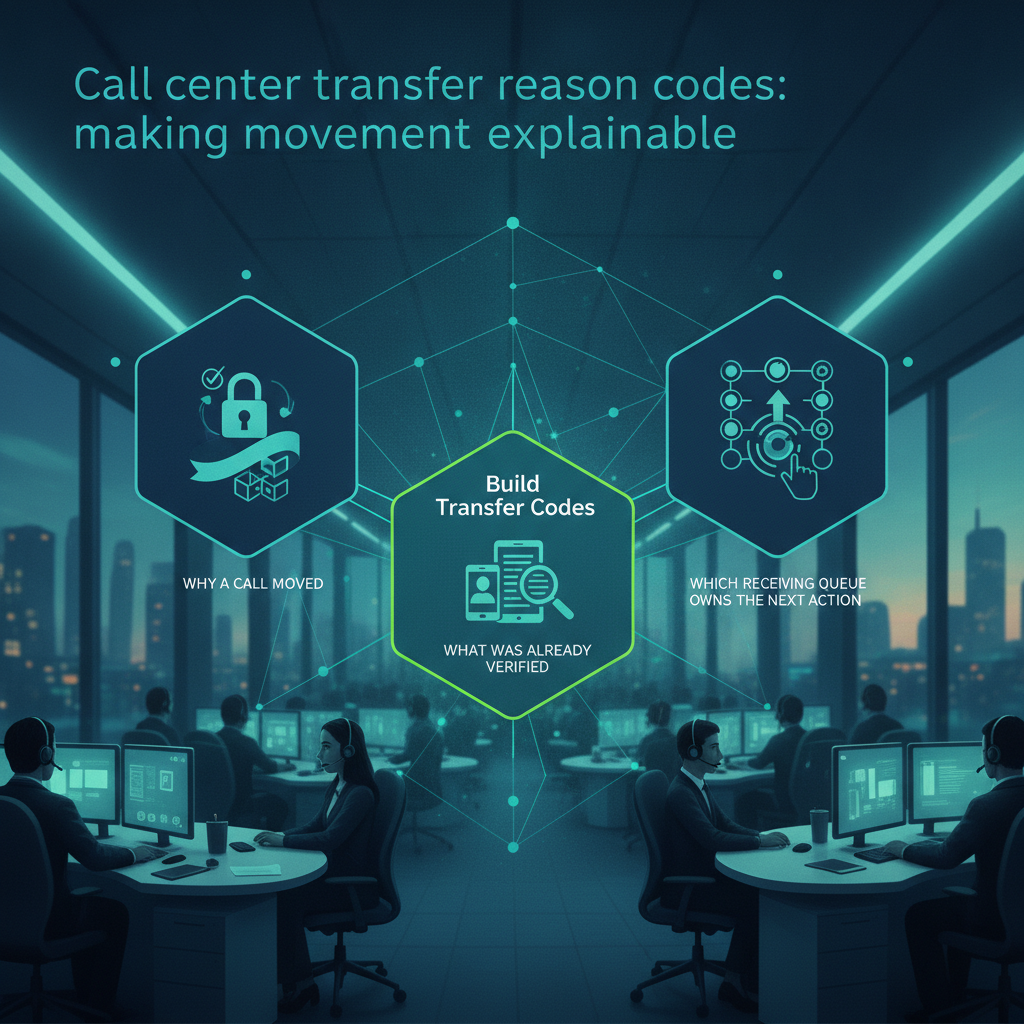
In the complex ecosystem of modern customer support, particularly within offshore call center operations, the seamless transfer of a customer's interaction is paramount. A poorly executed transfer is a primary source of customer frustration, leading to repeat explanations, extended handle times, and ultimately, dissatisfaction. Conversely, a well-managed transfer, where context is preserved and the customer feels understood, elevates the experience. This is where a robust system of transfer reason codes becomes indispensable, acting as a crucial communication layer that explains *why* a call moved, *what was already verified*, and *which receiving queue owns the next action*.
The Imperative of Intelligent Call Transfers in Offshore Operations
Offshore call centers often serve as the first point of contact for a broad spectrum of customer inquiries. Their efficiency and ability to resolve issues promptly are direct indicators of their value. However, not every call can be resolved by the initial agent. Transfers are an inevitable part of the customer journey, but they don't have to be a point of friction. In a distributed environment, where agents may be thousands of miles apart, potentially across different time zones and even speaking different dialects, explicit communication becomes even more critical.
Without standardized transfer reason codes, an agent receiving a transferred call often starts from scratch. This leads to customers repeatedly recounting their story, a phenomenon known as "customer effort" that directly correlates with dissatisfaction. For offshore teams, this also means potential efficiency drains as agents spend more time gathering context rather than resolving the issue. Implementing a structured code system transforms transfers from a disruptive event into a streamlined handoff, empowering both agents and customers with clarity and efficiency.
Deconstructing the "Why": Granular Transfer Triggers
The first component of an effective transfer reason code explains the fundamental "why" behind the movement. This provides immediate context for the receiving agent, guiding their approach and preventing redundant questioning. For offshore Level 1 (L1) agents, clear guidelines on when and why to transfer are vital to maintain service level agreements and prevent unnecessary escalations.
Categorizing transfer reasons should be intuitive and comprehensive. Common categories include:
* **Skill-Based Routing:** The initial agent lacks the specific expertise (e.g., technical troubleshooting beyond basic resets, complex billing inquiries, product-specific knowledge). * *Example Code Segment:* `SKILL-TECH`, `SKILL-BILLING`, `SKILL-PRODUCT_X`. * **Departmental Transfer:** The inquiry falls outside the scope of the current department or service line (e.g., sales lead to sales, warranty claim to warranty department). * *Example Code Segment:* `DEPT-SALES`, `DEPT-WARRANTY`, `DEPT-ACCOUNT_MANAGEMENT`. * **Escalation:** The customer explicitly requests a supervisor, or the L1 agent determines the situation requires higher authority (e.g., policy override, complaint resolution). * *Example Code Segment:* `ESCAL-SUPERVISOR`, `ESCAL-COMPLAINT`. * **Technical Limitation:** The L1 agent’s tools or access prevent resolution (e.g., requiring backend system access for a complex data modification). * *Example Code Segment:* `TECH-SYSTEM_ACCESS`, `TECH-DATA_MOD`.
These "why" segments, often combined with other elements, allow for immediate comprehension of the transfer's initial impetus. For an offshore agent, understanding the precise `SKILL-TECH` code, for instance, means they know exactly what kind of technical problem is at hand, minimizing the need for extensive verbal summaries that might be affected by accents or communication styles.
Contextualizing the Handoff: "What Was Verified?" Data Elements
Beyond knowing *why* a call is transferring, the receiving agent must understand *what has already been accomplished*. This crucial "verified" component prevents customers from repeating information and ensures continuity. For offshore operations handling high volumes, minimizing redundant data capture is a significant efficiency gain.
This segment of the transfer code or accompanying notes should indicate specific customer details or actions taken by the transferring agent. Key elements to include:
* **Customer Identity Verification:** Confirming the customer’s identity is often the first step in any interaction. This should be explicitly flagged. * *Example Code Segment:* `ID-VERIFIED` * **Problem Statement & Initial Diagnosis:** What was the customer's stated issue, and what was the initial agent's understanding or preliminary diagnosis? * *Example Code Segment:* `ISSUE-REPORTED_FAULTY_DEVICE`, `DIAG-INIT_TROUBLESHOOT_FAILED` * **Troubleshooting Steps Performed:** Listing steps already taken prevents the receiving agent from asking the customer to repeat actions. This is especially vital for technical support. * *Example Code Segment:* `TS-REBOOT_DONE`, `TS-DIAGNOSTICS_RUN`, `TS-KBA_CONSULTED` * **Previous Interaction Review:** Was the customer's account history or prior cases reviewed? * *Example Code Segment:* `PREV-CASE_REVIEWED_LAST_30D` * **Customer Preferences/Details:** Any specific preferences or critical information provided by the customer. * *Example Code Segment:* `PREF-CALLBACK_AFTER_5PM`, `NOTE-CUSTOMER_UPSET`
A complete code might look like: `SKILL-TECH_ID-VERIFIED_TS-REBOOT_DONE`. This instantly tells the receiving technical agent that identity is confirmed and a basic reboot has already been attempted, allowing them to dive deeper immediately. Documentation in the CRM system (evidence to retain) should always accompany these codes, detailing the specifics of the verification or troubleshooting. Failure to document adequately can lead to the very repetition the codes are designed to prevent, making agent training on consistent notetaking essential.
Directing the Flow: "Who Owns Next Action?" Queue Ownership and Routing
The final, critical piece of the transfer code puzzle is designating *which receiving queue or team owns the next action*. This isn't just about routing; it's about assigning accountability and ensuring the call lands with the truly appropriate specialist, not just the next available agent. Without this clarity, a call might bounce between departments, further exacerbating customer frustration.
Designing these ownership segments requires a deep understanding of your internal call flow, skill sets, and departmental boundaries.
* **Specific Skill Group:** Routing to a dedicated group for a particular skill set. * *Example Code Segment:* `TO-TECH-L2-NETWORK`, `TO-BILLING-ADJUSTMENT`, `TO-RETENTION-SPECIALIST`. * **Escalation Queue:** Directing calls to a specific team trained to handle elevated complaints or supervisor requests. * *Example Code Segment:* `TO-SUPERVISOR-QUEUE`, `TO-CUSTOMER_RELATIONS`. * **Specialized Department:** For issues requiring specific departmental expertise. * *Example Code Segment:* `TO-FRAUD_DEPT`, `TO-LEGAL_COMPLIANCE`.
The combination of all three parts creates a powerful communication tool: `SKILL-TECH_ID-VERIFIED_TS-REBOOT_DONE_TO-TECH-L2-NETWORK`. This code instructs the ACD system to route the call to the L2 Network Support queue, signaling that the customer has a technical issue, identity is confirmed, initial troubleshooting is complete, and the network team is now responsible for the next steps.
Practical decisions here involve meticulously mapping these `TO` codes to actual queues within your Automatic Call Distributor (ACD) or Interactive Voice Response (IVR) systems. Failure modes include outdated routing maps, agents selecting incorrect `TO` codes due to lack of training, or a receiving queue being unprepared for the type of transfer designated by the code. Regular audits of transfer paths and agent selections are vital to maintain accuracy.
Crafting Your Transfer Code Lexicon: A Measured Implementation Path
Developing a robust system of transfer reason codes is an iterative process, not a one-time project. For offshore operations, clear, unambiguous definitions are paramount to overcome potential linguistic nuances and ensure consistent application across diverse agent pools.
1. **Phase 1: Inventory & Analysis.** Start by analyzing existing transfer reasons. Gather data from call recordings, CRM notes, and agent feedback. What are the most common reasons for transfers? What information is most frequently repeated by customers? Involve agents from both L1 (offshore) and L2/specialized teams to gain a comprehensive view. 2. **Phase 2: Define the Lexicon.** Based on your analysis, begin defining your codes. Start with a foundational set and expand as needed. Structure them logically, potentially using a multi-part format (Reason-Verified-Owner) for clarity. Provide concise definitions for each segment and examples of appropriate use. 3. **Phase 3: Training & Rollout (Pilot).** Comprehensive training is non-negotiable, especially for offshore teams. Agents must understand not only *what* each code means but also *why* it's important and *how* to select the most appropriate code. Begin with a pilot program involving a small group of experienced agents. Collect feedback on code clarity, ease of use, and any unforeseen issues. 4. **Phase 4: Integration & Monitoring.** Integrate the codes into your agent desktop applications and CRM. Make selection quick and intuitive. Implement reporting mechanisms to track code usage, transfer success rates, and identify frequently misused codes or persistent transfer reasons that could indicate training gaps or process inefficiencies. This data will be your evidence base for continuous improvement. 5. **Phase 5: Iteration & Refinement.** Regularly review your code lexicon. As services, products, or processes evolve, so too must your transfer codes. Solicit ongoing feedback from agents and supervisors. Is there a need for new codes? Are existing codes ambiguous? Refine and update as necessary, ensuring all offshore sites are aligned.
Beyond the Code: Operationalizing Smart Transfers
Implementing transfer reason codes is more than just adding a field to a form; it's a strategic shift towards more intelligent call routing and enhanced customer experiences. For offshore call centers, this translates into tangible benefits:
* **Improved Customer Satisfaction:** Customers appreciate not having to repeat themselves, feeling their time is respected, and experiencing a smoother journey. This directly impacts overall satisfaction metrics, a key performance indicator for offshore centers. * **Increased Operational Efficiency:** Receiving agents save time on context-gathering, reducing Average Handle Time (AHT) and allowing them to focus on resolution. This efficiency gain can be substantial across high-volume offshore operations. * **Enhanced Agent Empowerment & Morale:** Both transferring and receiving agents benefit. Transferring agents feel confident their customer is being handed off effectively, while receiving agents are better prepared. This reduces stress and improves job satisfaction, which is crucial for agent retention in offshore centers. * **Richer Data Analytics:** The codes provide invaluable data. You can identify common transfer patterns, pinpoint skill gaps in L1 offshore teams, analyze the types of issues that require specialist intervention, and measure the effectiveness of your routing strategies. This data drives continuous improvement in training, processes, and service design.
By meticulously crafting, implementing, and continually refining transfer reason codes, offshore call center operations can transform a common point of customer friction into a hallmark of efficient, customer-centric service. This system elevates the entire support ecosystem, making every movement explainable and every customer journey smoother.